Animism

Arguably the proper label for the type of religion practiced among traditional indigenous people who employ shamans. Rather than being “shamanists” or adherents of “shamanism,” these people may be usefully named “animists.” While the term was coined by Edward Tylor (a founder of the discipline of anthropology) to define the essence of religion as “the belief in spirits” and has played a significant role in theories about the origins of religion, it is used here in a new way. The old theory of animism alleged that indigenous people and the earliest human ancestors had made a mistake in believing in spirits. The new theory, associated with Nurit Bird-David, Eduardo Viveiros de Castro, Signe Howell, and others, sees animism as a relational ontology—the recognition that the world is full of persons, only some of whom are human. In Irving Hallowell’s terms, there are human persons and other-than-human persons, including rock persons, tree persons, cloud persons, and perhaps “spirit persons.” Animist worldviews and lifeways make it necessary for there to be shamans because (1) humans are relatively weak and need to seek help (in the form of knowledge, healing, or defense) from more powerful other-than-human persons and (2) humans often offend otherthanhuman persons and need mediators  in order to restore respectful relationships. In this context, shamans may be defined as those persons trained and skilled at working for their community when it is necessary to seek help from or reconciliation with the wider community of life. In turn, as Graham Harvey has argued, animism makes shamans both possible and necessary because their roles are about dealing with the problems of a living world.    However, in concluding a discussion of blood, tobacco, jaguars, and shamans, Carlos Fausto  describes Amazonian shamanism as “a predatory animism.” This sinister conclusion is based on the fact that the ability of some people (shamans) to interact relationally (e.g., by adoption or alliance) with powerful other-than-human persons (especially jaguars) depends on predation in warfare and hunting because these are preferred means of affirming one’s agency and intentionality rather than being used, preyed upon, by other persons. In short, shamans are necessary in animist communities as both curers and combatants.

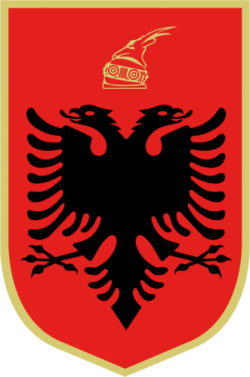
Coat of arms of Albania

The coat of arms of Albania is an adaptation of the flag of Albania. It is based on the seal of Gjergj Kastriot Skanderbeg. The emblem above the head of the two-headed eagle is the helmet of Skanderbeg, surmounted with billy goats’ horns.

The emblem has dimensions of 1:1.5. It is sometimes considered to violate the rule of tincture, because in English and French heraldry, sable (black) is considered a colour, whereas elsewhere it is often considered a fur.

Skanderbeg’s helmet is made of white metal, adorned with a strip dressed in gold. On its top lies the head of a horned goat made of bronze, also dressed in gold. The bottom part bears a copper strip adorned with a monogram separated by rosettes * IN * PE * RA * TO * RE BT *, which means: Jhezus Nazarenus * Principi Emathie * Regi Albaniae * Terrori Osmanorum * Regi Epirotarum * Benedictat Te (Jesus Nazarene Blesses Thee [Skanderbeg], Prince of Mat, King of Albania, Terror of the Ottomans, King of Epirus). It is thought that the copper strip with the monogram is the work of the descendants of Skanderbeg and was placed there by them, as Skanderbeg never held any other title but “Lord of Albania” (Dominus Albaniae) Thus the inscriptions on the helmet may refer to the unsettled name by which Albania was known at the time, as a means to identify Skanderbeg’s leadership over all Albanians across regional denominative identifications. Contemporary sources show that 14th century Albanians were invariably identified as a tribal peoples, with no state of their own. Thus, depending on where they lived – North or South, in the plains or in the mountains, and to which civilization they subscribed to – we have Turkish Arnauts, Greek Arbanites or Albanoi, Albanian Arber, Arben, Arberesh, Epirotas.

According to a report by historian Shefqet Pllana, Sami Frasheri in his Kamus-al-Alam maintains that the wording “Dhu lKarnejn” (owner of the two horns) was an appellative attributed to Alexander the Great of Macedon, the very name which Skanderbeg bore in the Islamic form. This second explanation may not be the truer, since the theory of the Macedonian-Albanian and Epirot-Albanian continuance is strong among Albanians but not among all the peoples of Europe. This opinion agrees with the work of Marin Barleti who writes: “When the people saw all those young and brave men around Skanderbeg, then it was not hard to believe that the armies of [Sultan] Murat were so defeated by the Albanians. Indeed, the times when the star of Macedon shone brilliantly had returned, just as they seemed in those long forgotten times of Pyrrhus and Alexander.”

Lynn Atchison Beech

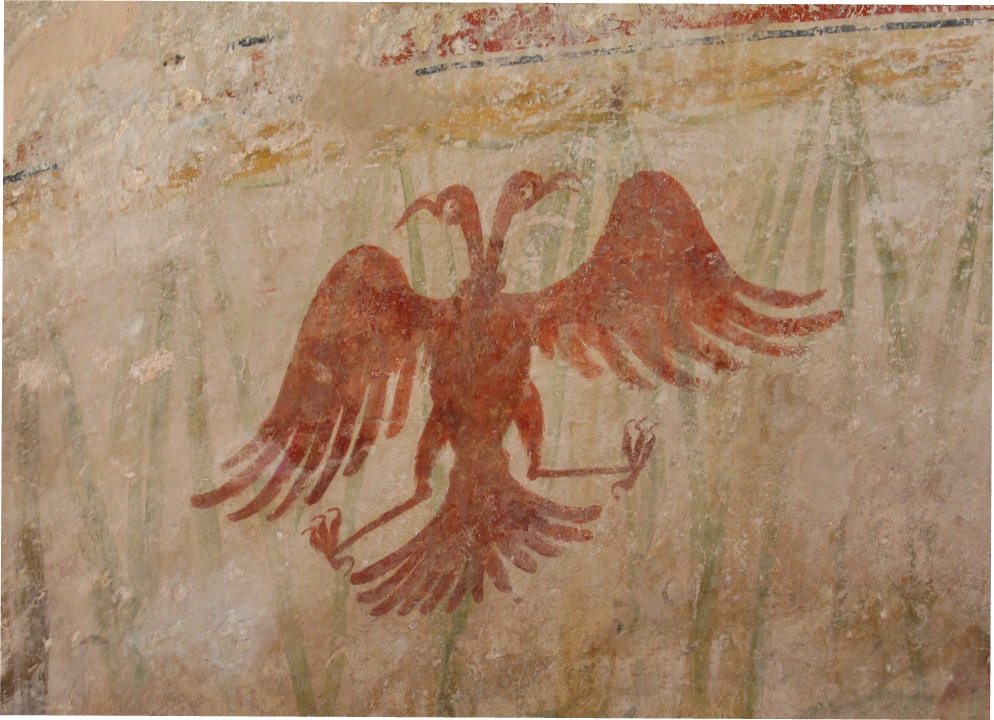
Darstellung eines Doppeladlers in der St. Antonius-Kirche am Kap Rodon (credit: Wikipedia,Decius)