The saying “Pushteti absolut korrupton absolutisht,” which translates to “Absolute power corrupts absolutely,” is a timeless observation on the nature of power and its effects on morality. This phrase is attributed to the 19th-century British politician Lord Acton. Although the idea had been expressed in various forms before, it was Lord Acton’s articulation that has become most renowned.
The essence of this saying is that as an individual’s power increases, their sense of morality and responsibility towards others diminishes. This concept has been observed throughout history, with numerous examples of leaders who, upon gaining absolute power, have allowed it to erode their ethical compass.
In the context of Albania, one can look to the period following the fall of communism in 1991. The sudden absence of a structured political system led to a power vacuum that was quickly exploited by a clientelist regime. This regime often had close ties to organized crime, such as drug trafficking, which further corrupted the political landscape.
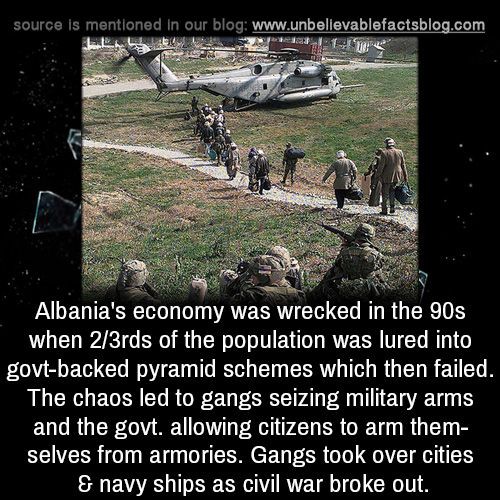
One notable example is the pyramid schemes crisis of the mid-1990s. The Albanian government, under President Sali Berisha, was accused of being deeply involved in these fraudulent investment funds, which led to widespread corruption at the highest levels of power. When the schemes collapsed, it resulted in financial ruin for many Albanians and sparked civil unrest and violence across the country.
This crisis exemplified the saying “Pushteti absolut korrupton absolutisht,” as the unchecked power of the government officials allowed them to engage in corrupt practices with little regard for the welfare of the populace. It serves as a historical reminder of the dangers of absolute power and the importance of checks and balances in governance.
The legacy of this period still affects Albania today, as the country continues to grapple with corruption and its consequences. Efforts have been made to combat corruption, but the journey towards transparency and accountability is ongoing.
In conclusion, the saying “Pushteti absolut korrupton absolutisht” is not only a reflection of historical events but also a relevant caution for current and future leaders. It underscores the need for vigilance and integrity in the exercise of power, lest history repeats itself with the same tragic outcomes.
The term **gjakmarrje**, translating to “blood-taking” or “blood feud,” is deeply entrenched in Albanian culture. It represents a social obligation to kill an offender or their family member to restore one’s honor. This practice aligns with the **Canon of Lekë Dukagjini** or simply the **Kanun**, a code consisting of 12 books and 1,262 articles.
**Etymology and Phonology**
The word **gjakmarrje** is a compound of “gjak” (blood) and “marrje” (taking). Phonologically, it reflects the Albanian language’s rich history of sounds, with the voiced palatal approximant ‘j’ and the trilled ‘r’ playing a significant role in its pronunciation.
**Morphology**
Morphologically, **gjakmarrje** is a noun formed by combining two roots that convey the concept of taking revenge through blood, a notion that has shaped the societal and legal frameworks within Albanian communities.
**History**
Historically, gjakmarrje dates back to a time when Ottoman control was minimal in Albania, particularly in the mountains where Albanian highlanders lived autonomously by the Kanun. It was a non-religious code used by Muslims and Christians alike, emphasizing the protection of honor as a core value.
**Association within Albanian Society**
In Albanian society, gjakmarrje has been a mechanism for maintaining social order, especially in the northern highlands and remote areas. It has seen a resurgence due to the lack of state control post-communism². The practice often extends across generations if the ‘debt’ is not settled, leading to cycles of violence and retribution.
Efforts to address gjakmarrje include peace education and transforming attitudes to introduce socially acceptable alternatives to this violent conflict. Informal settings provide opportunities for such education, aiming to reduce the practice’s prevalence and impact.
In conclusion, gjakmarrje is more than a word; it’s a historical and cultural phenomenon that continues to influence Albanian society. Understanding its etymology, phonology, morphology, and history provides insight into its significant role and the ongoing efforts to mitigate its effects on modern Albanian life.
Arguably the proper label for the type of religion practiced among traditional indigenous people who employ shamans. Rather than being “shamanists” or adherents of “shamanism,” these people may be usefully named “animists.” While the term was coined by Edward Tylor (a founder of the discipline of anthropology) to define the essence of religion as “the belief in spirits” and has played a significant role in theories about the origins of religion, it is used here in a new way. The old theory of animism alleged that indigenous people and the earliest human ancestors had made a mistake in believing in spirits. The new theory, associated with Nurit Bird-David, Eduardo Viveiros de Castro, Signe Howell, and others, sees animism as a relational ontology—the recognition that the world is full of persons, only some of whom are human. In Irving Hallowell’s terms, there are human persons and other-than-human persons, including rock persons, tree persons, cloud persons, and perhaps “spirit persons.” Animist worldviews and lifeways make it necessary for there to be shamans because (1) humans are relatively weak and need to seek help (in the form of knowledge, healing, or defense) from more powerful other-than-human persons and (2) humans often offend otherthanhuman persons and need mediators in order to restore respectful relationships. In this context, shamans may be defined as those persons trained and skilled at working for their community when it is necessary to seek help from or reconciliation with the wider community of life. In turn, as Graham Harvey has argued, animism makes shamans both possible and necessary because their roles are about dealing with the problems of a living world. However, in concluding a discussion of blood, tobacco, jaguars, and shamans, Carlos Fausto describes Amazonian shamanism as “a predatory animism.” This sinister conclusion is based on the fact that the ability of some people (shamans) to interact relationally (e.g., by adoption or alliance) with powerful other-than-human persons (especially jaguars) depends on predation in warfare and hunting because these are preferred means of affirming one’s agency and intentionality rather than being used, preyed upon, by other persons. In short, shamans are necessary in animist communities as both curers and combatants.
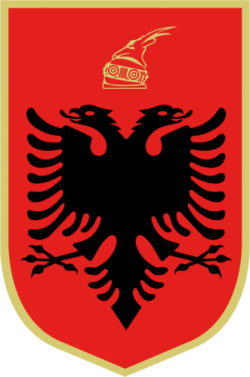
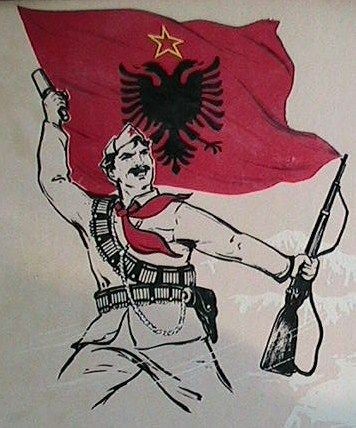
The coat of arms of Albania is an adaptation of the flag of Albania. It is based on the seal of Gjergj Kastriot Skanderbeg. The emblem above the head of the two-headed eagle is the helmet of Skanderbeg, surmounted with billy goats’ horns.
The emblem has dimensions of 1:1.5. It is sometimes considered to violate the rule of tincture, because in English and French heraldry, sable (black) is considered a colour, whereas elsewhere it is often considered a fur.
Skanderbeg’s helmet is made of white metal, adorned with a strip dressed in gold. On its top lies the head of a horned goat made of bronze, also dressed in gold. The bottom part bears a copper strip adorned with a monogram separated by rosettes * IN * PE * RA * TO * RE BT *, which means: Jhezus Nazarenus * Principi Emathie * Regi Albaniae * Terrori Osmanorum * Regi Epirotarum * Benedictat Te (Jesus Nazarene Blesses Thee [Skanderbeg], Prince of Mat, King of Albania, Terror of the Ottomans, King of Epirus). It is thought that the copper strip with the monogram is the work of the descendants of Skanderbeg and was placed there by them, as Skanderbeg never held any other title but “Lord of Albania” (Dominus Albaniae) Thus the inscriptions on the helmet may refer to the unsettled name by which Albania was known at the time, as a means to identify Skanderbeg’s leadership over all Albanians across regional denominative identifications. Contemporary sources show that 14th century Albanians were invariably identified as a tribal peoples, with no state of their own. Thus, depending on where they lived – North or South, in the plains or in the mountains, and to which civilization they subscribed to – we have Turkish Arnauts, Greek Arbanites or Albanoi, Albanian Arber, Arben, Arberesh, Epirotas.
According to a report by historian Shefqet Pllana, Sami Frasheri in his Kamus-al-Alam maintains that the wording “Dhu lKarnejn” (owner of the two horns) was an appellative attributed to Alexander the Great of Macedon, the very name which Skanderbeg bore in the Islamic form. This second explanation may not be the truer, since the theory of the Macedonian-Albanian and Epirot-Albanian continuance is strong among Albanians but not among all the peoples of Europe. This opinion agrees with the work of Marin Barleti who writes: “When the people saw all those young and brave men around Skanderbeg, then it was not hard to believe that the armies of [Sultan] Murat were so defeated by the Albanians. Indeed, the times when the star of Macedon shone brilliantly had returned, just as they seemed in those long forgotten times of Pyrrhus and Alexander.”
Lynn Atchison Beech
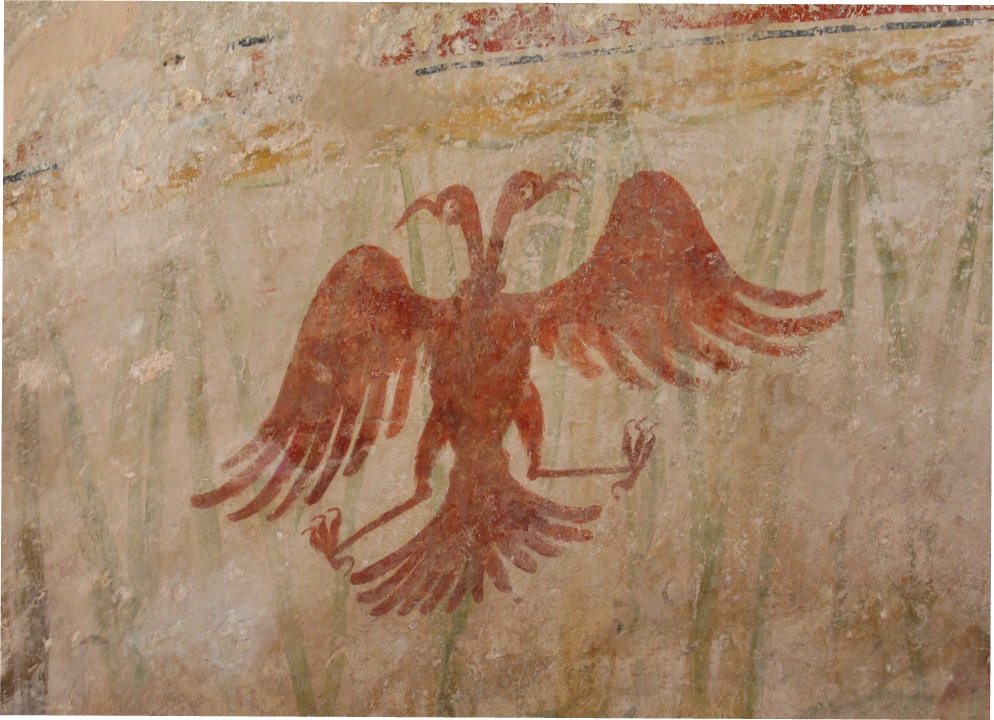
Darstellung eines Doppeladlers in der St. Antonius-Kirche am Kap Rodon (credit: Wikipedia,Decius)
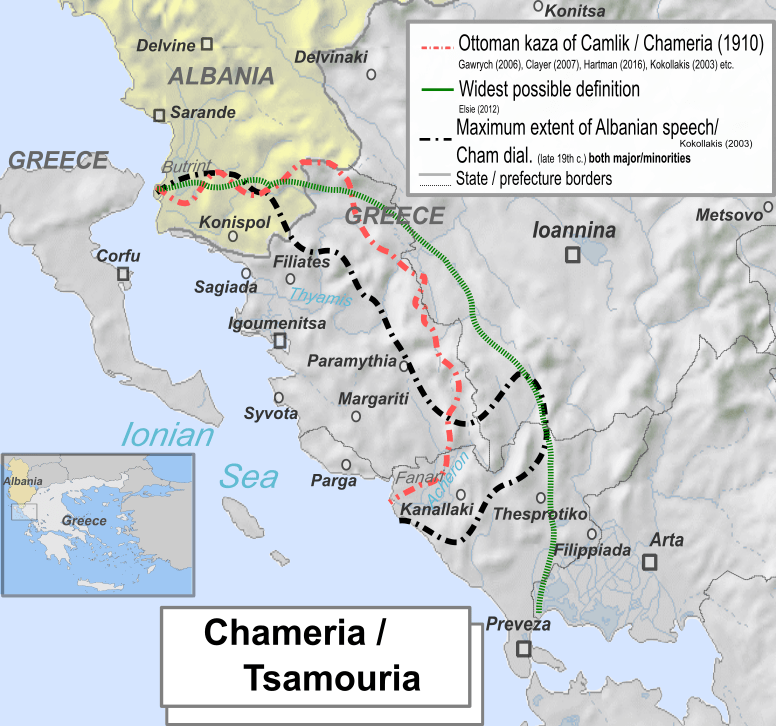
Chameria is a mountainous region of the southwestern Balkan Peninsula that now straddles the Greek-Albanian border. Most of Chameria is in the Greek Province of Epirus, corresponding largely to the prefectures of Thesprotia and Preveza, but it also includes the southern-most part of Albania, the area around Konispol. It is approximately 10,000 square kilometres in size and has a current, mostly Greek-speaking population of about 150,000. The core or central region of Chameria, known in Greek as Thesprotia, could be said to be the basins of the Kalamas and Acheron Rivers. It was the Kalamas River, known in ancient times as the Thyamis, that gave Chameria its name.
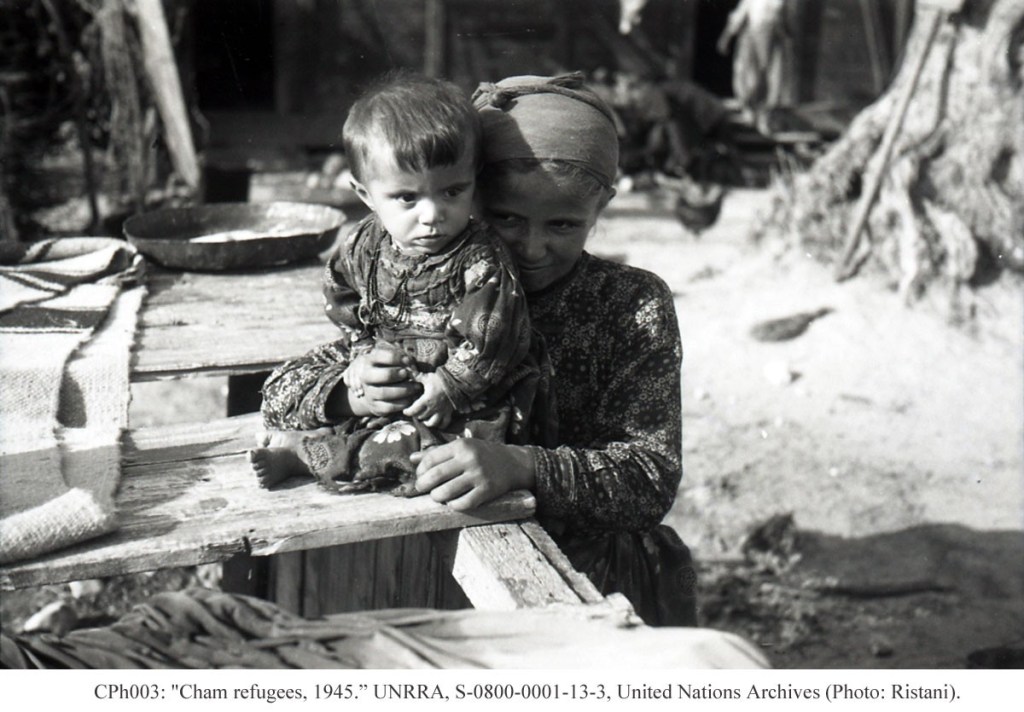
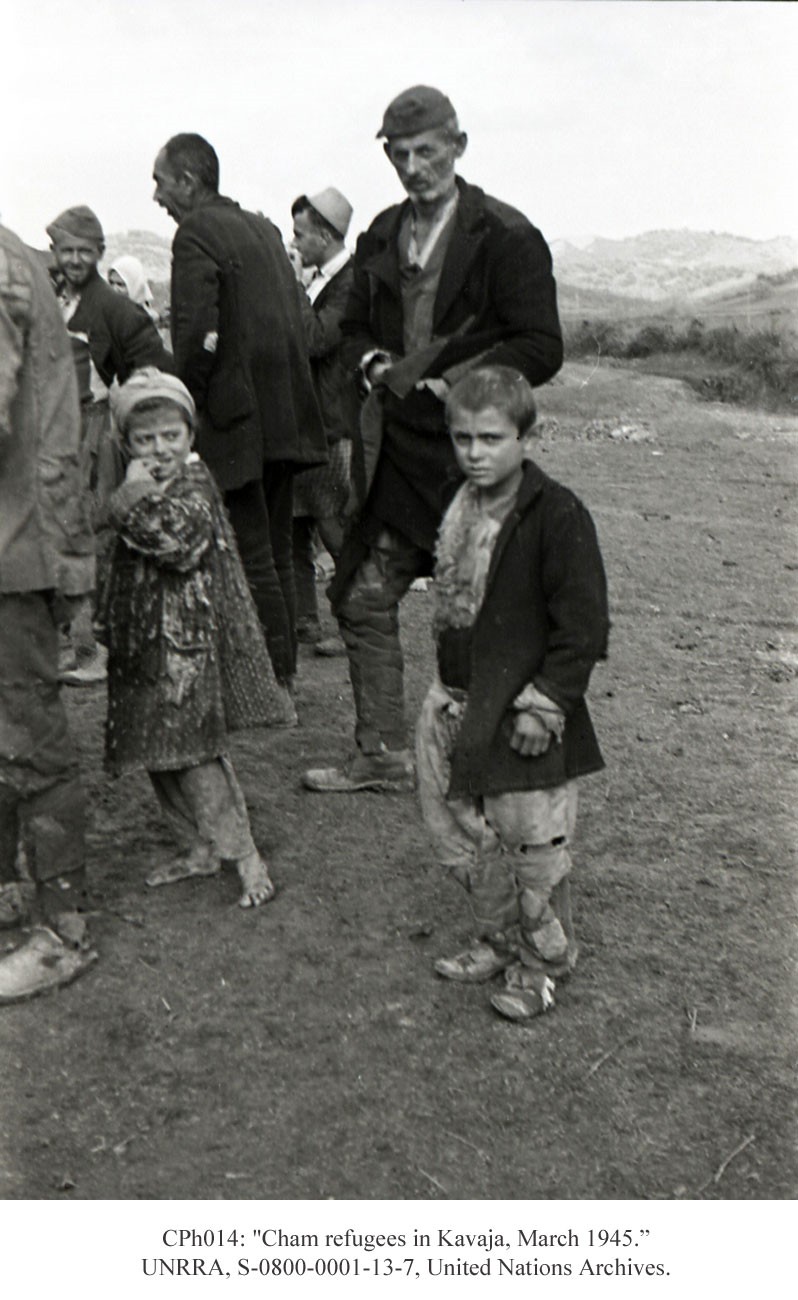
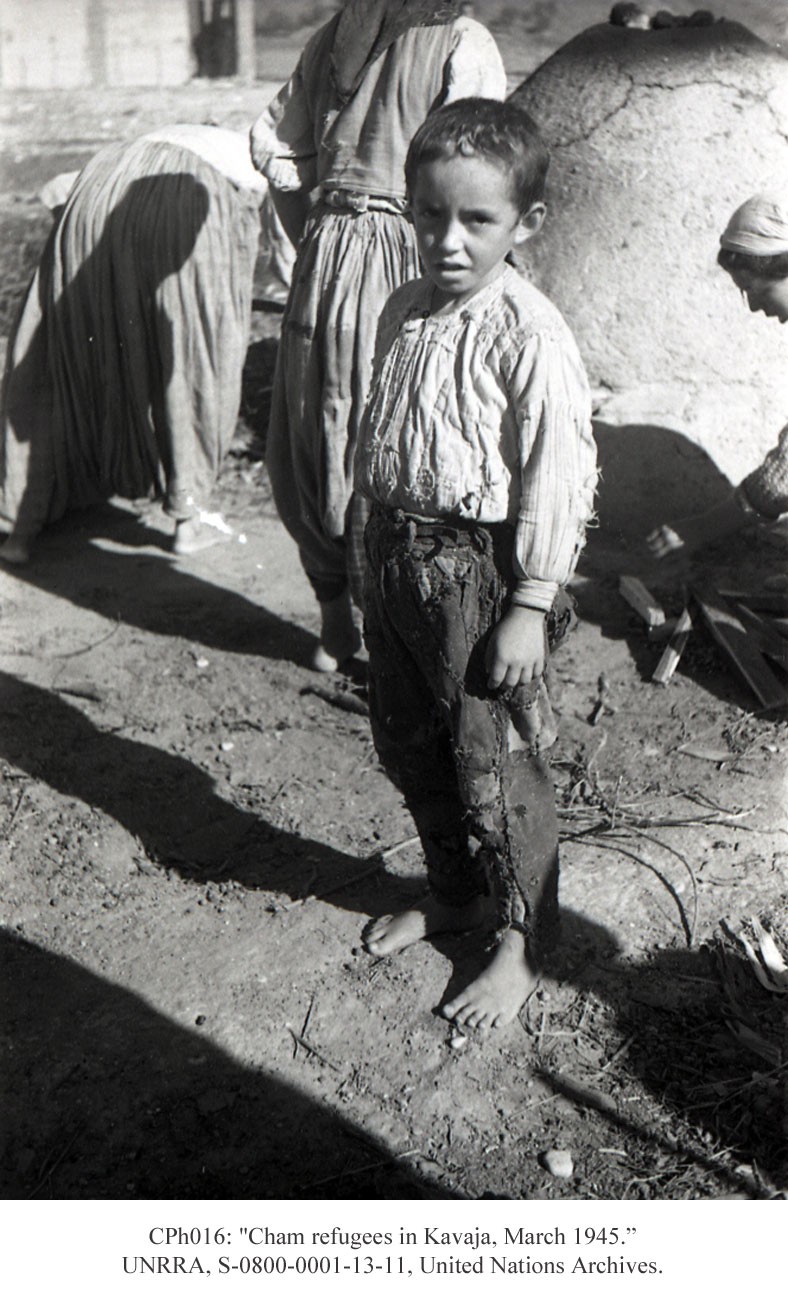
The Chams, known in Greek as Tsamides, are no other than Albanians living in the extreme southern part of Albanian-speaking territory. Among their traditional settlements in the now relatively sparsely inhabited region of Chameria were Gumenica/Igoumenitsa, Filat/Filiates, Paramithia/Paramythia, Parga and Margëlliç/Margariti and, in particular, many smaller villages that were abandoned and are in ruins and presently covered in vegetation. There were Cham settlements sporadically southwards as far as Preveza. When Greek forces took possession of Chameria and southern Epirus in the Balkan War of 1912, the Chams suddenly found themselves in Greece, cut off from the rest of Albania. In the following decades, in particular the 1920s, 1930s and 1940s, the vast majority of the Chams emigrated or were expelled from Chameria. With the German withdrawal from Greece in the summer and early autumn of 1944, the region was enmeshed in the initial throes of a bloody civil war. British forces, anxious to secure the Ionian coastline in order to ensure maritime supply routes, encouraged the forces of a local military commander, General Napoleon Zervas (1891-1957), to take over the region. Zervas, the founder and leader of a Greek resistance movement called the National Republican Greek League (Ethnikós Demokratikós Ellenikós Sýndesmos – EDES), became known for his brutal ethnic cleansing of the Albanians of Chameria from June 1944 to March 1945. He and many of his men regarded the Chams collectively as collaborators with the Italians and Germans, and sought vengeance. Several thousand men, women and children from Chameria found their deaths during his incursions. On 27 June 1944, his forces entered the town of Paramithia and killed about 600 Muslim Chams – men, women and children – in an orgy of violence. Many of the victims were raped and tortured before being slaughtered. Another EDES battalion advanced into Parga the next day where 52 more Albanians were killed. On 23 September 1944, the village of Spatar near Filat was looted and 157 people were murdered. Numerous young women and girls were raped, and other unspeakable crimes were committed. In the immediate aftermath, virtually the entire Cham population, defenceless and petrified, took to the hills and fled for their lives to Albania. The Chameria Association in Tirana estimates that a total of 2,771 Albanian civilians were killed during the 1944-1945 attacks on Cham villages.The cleansing of the Muslim Chams of Greece at the end of the Second World War marked the end of a one painful chapter of Cham history and the beginning of another. The Albania, to which the exhausted and starving Chams fled, had shortly before their arrival come under the control of Enver Hoxha (1908-1985) and his communist forces. The new Marxist rulers were not entirely disposed to assist their suffering compatriots. The Chams were nonetheless given refugee status and allowed to remain in Albania. It was the United Nations Relief and Rehabilitation Administration (UNRRA), active as a relief agency in Albania from September 1945 to the spring of 1947, that provided emergency assistance to the Chams by distributing tents, food and medicine to their squalid camps in Vlora, Fier, Durrës, Kavaja, Delvina and Tirana. In the years immediately following the Second World War, the Anti-Fascist Committee of Cham Immigrants campaigned for the return of the Chams to their homeland. Most of them did not want to stay in Albania anyway, in particular in view of the Stalinist-type purges taking place there. The Committee held two congresses in 1945, one in Konispol and the other in Vlora, and wrote memoranda and sent telegrams in support of its goals. The Cham issue was also brought up by Albania at the Paris Peace Conference of 1946, but all of these activities proved to be in vain. Efforts to internationalize the Cham issue fell, for the most part, on deaf ears. For several years, the Chams continued to hope that when the political situation calmed down, they would be able to return to Greece. However, this did not happen. Even today, in the twenty-first century, elderly Chams wishing to see the land of their birth, even on a short visit, are turned back at the border by Greek customs officials. Their passports are stamped persona non grata and on occasion are even torn up before their very eyes.
Robert Elsie
These photos were taken in 1945 at Cham refugee camps in Albania by members of the United Nations Relief and Rehabilitation Administration (UNRRA).
Outside observers tend to think of Albania as a monolithic bloc, but just below the “Greater Albania” surface is a depth of societal division, periodically drained by the “unifying” valve of ethnic irredentism. The country is suffering from such a degree of corruption and mismanagement that thousands of its citizens have opted to flee and begin their lives anew in Germany, which has only contributed to the economic crisis that Albania has found itself in and raises fears of oncoming political unrest. Something else that needs to be spoken about when addressing domestic Albanian divisions is the potential for the Gheg and Tosk geographical dialect divisions to coalesce into concrete regionalist identities that weaken the cohesiveness of the Albanian state.
Squeezed between grassroots socio-economic pressures and the threat that the geo-dialect divide might one day take on political contours, the Tirana elite has resorted to the myth of “Greater Albania” in order to maintain ‘unity’ and redirect society’s growing anger towards a ‘regional crusade’. What they may not have calculated, however, is that the country’s strategic Christian minority might one day identify closer with their neighboring co-confessionalists than the with the diversion of “Greater Albania”, and if they take the lead in exposing this charade, then the entire national fabric might eventually unravel in unpredictable directions.
The article starts off by highlighting the economic desperation prevalent in Albania and its occupied colony of Kosovo and how the huge migrant flows this has stimulated have given Tirana’s elite a serious cause for self-interested concern. Afterwards, it explores the Gheg and Tosk dialect divide and the prospects for its politicization in the future, especially in the absence of a ‘unifying’ “Greater Albania” ideology or a major weakening thereof. Part II continues the research by examining the potential for Albania’s Christian minority to play the vanguard role in leading the domestic resistance to the “Greater Albania” ‘theology’. Following that, it looks at the possibility of the government responding through a Turkish-supported ‘soft’ Islamization of society to counter the Christian dissidents, with all of the unintentional and explosive problems that this could predictably create. Finally, the work concludes by assessing the most probable impact of all these processes on Albanian society and touching upon three interrelated scenarios.
Lost amidst the news-grabbing headlines about the Mideast’s migrant crisis to Europe is the internal one that hit uncontrollable proportions at the beginning , but was soon eclipsed by its more politically convenient counterpart. The Independent Balkan News Agency reported in April that 20,000 Albanians had already left their country in search of better opportunities in the EU, with The Telegraph writing in late February that 50,000 Albanians had left Kosovo by that time for the same reason. Taken together, that’s at least 70,000 Albanians that have fled the Balkans by early 2015, but unfortunately for observers, news coverage about this mass exodus was overshadowed as the Mideast migrant crisis began spiraling out of control, and it has since then been extremely difficult to find reliable figures about the number of Albanian migrants since, let alone any detailed coverage in general.
Step Out Of The Shadows, Get Deported:
A mid-summer article from Euroactiv counted around 8,000 Albanians requesting asylum in Germany, despite the 2% or so success rate for that group at the time. More than likely, the rest of the at least 70,000 Albanian migrants didn’t even want to apply for asylum because they knew the almost impossible odds of receiving this benefit and also suspected their departure entities would soon be put on a list of “safe countries” that would lead to the deportation of 98% of those said applicants. Choosing instead to treat their stay in Germany not as a lifelong new beginning but an indefinite working trip, they opted not to notify authorities of their presence. In hindsight, this was a wise decision on their part because Germany eventually did declare Albania and “Kosovo” “safe countries” and has already begun deporting 716 of the prior applicants (almost 9% of the total) back to Tirana within a month of making the decision.
Unwanted In Their Own Country:
Although proportionately small in number when compared to all the Albanians that have fled so far this year (and obviously more by now than the 70,000 that were counted in spring), Tirana is afraid that a large wave of deported individuals will soon arrive back in the country. These angry and unemployed individuals might rightly begin agitating against the government and demanding real economic change in their country, and that’s what really makes the elite anxious. Furthermore, deported Albanians that return to the occupied Serbian Province of Kosovo might refrain from making such a trip again and instead opt to find a job in Albania instead, which would further strain the domestic labor market and increase unemployment.
Liberation Day is celebrated in Albania on November 29. This holiday was established to celebrate the day, when Albania was liberated from Nazi occupation during World War II on November 29, 1944.
Nazi Germany occupied Albania in 1943. The guerrilla forces were driven to the hills and to the south of Albania. Berlin established Albanian government, military and police, declaring, that Germany would recognize independence of the nation only in the case of its neutrality.
The National Liberation Army and the guerrillas liberated Albania from German occupation on November 29, 1944. The partisans, who liberated Albania, also assisted liberation of southern Bosnia and Herzegovina, and part of Montenegro.
Celebration of Liberation Day in Albania on November 29 is a disputable issue. Some believe, that this date was chosen by the Communist Party of Albania to coincide with the liberation date of Yugoslavia.
Liberation Day is a non-working holiday in Albania. It follows another public holiday, Independence Day, that is why people have a longer break to enjoy time with their families and friends.
The French diplomat and writer, Baron Alexandre Degrand (1844-1911), was born in Paris where he joined the French foreign service. From 1893 to 1899 he served as French consul in Shkodra. Baron Degrand was especially interested in the history of the region, in particular its prehistory and antiquity, and visited fortresses, mediaeval churches and ruins, noting what he saw and what he was told by the people he met. Two years after his departure from Albania, he published his ‘Souvenirs de la Haute-Albanie’ (Memories of High Albania), Paris 1901, a well-documented description of northern Albania of the period. The following is the narrative of his visit to Tirana.
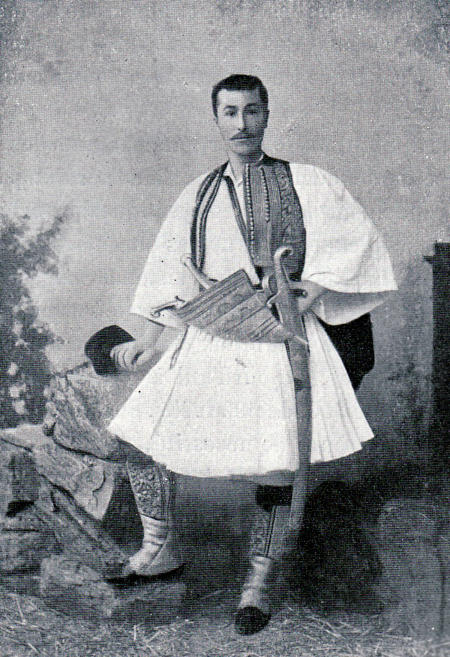
The bey of Tirana in national dress(photo: Alexandre Degrand 1901)
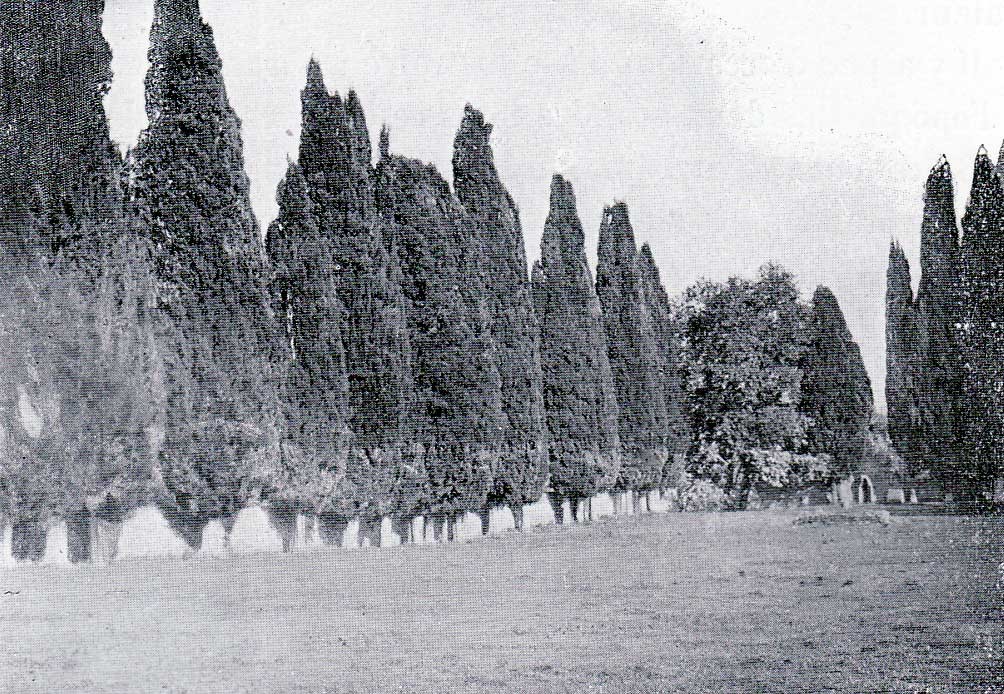
A good horse can easily get you from Durrës to Tirana in eight hours if the countryside is not wet. You leave ancient Petra to your right, where the Roman Senate once camped out during the conflict with Caesar, and continue in open country dotted with groves of trees here and there. It is fertile land and yields a good harvest. The people work out in the fields without their rifles, and they look less wild. I would like to have seen their homes, but did not meet any of them along the way. The fair plain is sparsely populated – vast stretches of uncultivated land with no people at all and, what is more, no roads to transport rice and other cereals to Durrës, the port of departure. Entering Tirana is a charming experience, and a very agreeable impression is to be had from the houses in the outskirts and the beautiful trees in the extensive gardens. The journey ends on a large square on which are situated a clock tower and the Haji Ethem Bey Mosque.The mosques of Tirana are all covered in ornaments and tempera painting and their bright colours produce a wonderful effect in the sunshine. None of the towns I have visited in Albania has so much character. Founded by a Muslim, it has changed little in the last three or four centuries. One does not see the transformations and changes one encounters in other towns. It is the town in which Muslims find what they are always looking for: water, flowers, good fruit and an agreeable climate, i.e. a place where life is good. It has an important and curious bazaar, with wooden houses and galleries, enormous caravanserais, and alleyways continuously cleansed by streams of flowing water. The population is thought to be about 25,000.
The ‘namazgjah’ (prayer grounds) of Ahmed Bey in Tirana (photo: Alexandre Degrand 1901).
I had just got off my horse at the caravanserai where I intended to stay, when Mr Petrovici, the director of the Régie Ottomane des Tabacs in Durrës, having heard of my arrival, came to see me and inform me on behalf of Fuad Bey, one of the rich landowners in the region, that rooms had been made available for me and my entourage. He noted that when news of my arrival spread, several beys had wanted to be my host and, had he not been in the house of Fuad Bey, who convinced them to give way so that we could all be together, I would have been forced to choose from among several invitations. Fuad Bey received me very kindly. He was still quite a young man and was dressed in European fashion. He had been abroad and both he and his children bought their clothes in Paris. To my great surprise, the room to which I was led, was completely furnished in French style, including the bed. As a result, of course, it lacked local colour, but I must admit I felt very much at home there. The hospitable reception was charming and boundless. It was the home of a great landowner. The table, on which a great variety of meals were offered to us, was often used by up to thirty passing visitors. Both wine and beer were set out for me.
Gypsy dancers in Tirana (photo: Alexandre Degrand 1901).
I spent many leisurely hours in the garden under the orange trees, listening to the prattle of the children and answering the questions of my host’s daughter and niece. It was a great surprise when he acquainted me
Excerpt from Alexandre Degrand, Souvenirs de la Haute-Albanie (Paris 1901), p. 184-196. Translated from the French by Robert Elsie.]
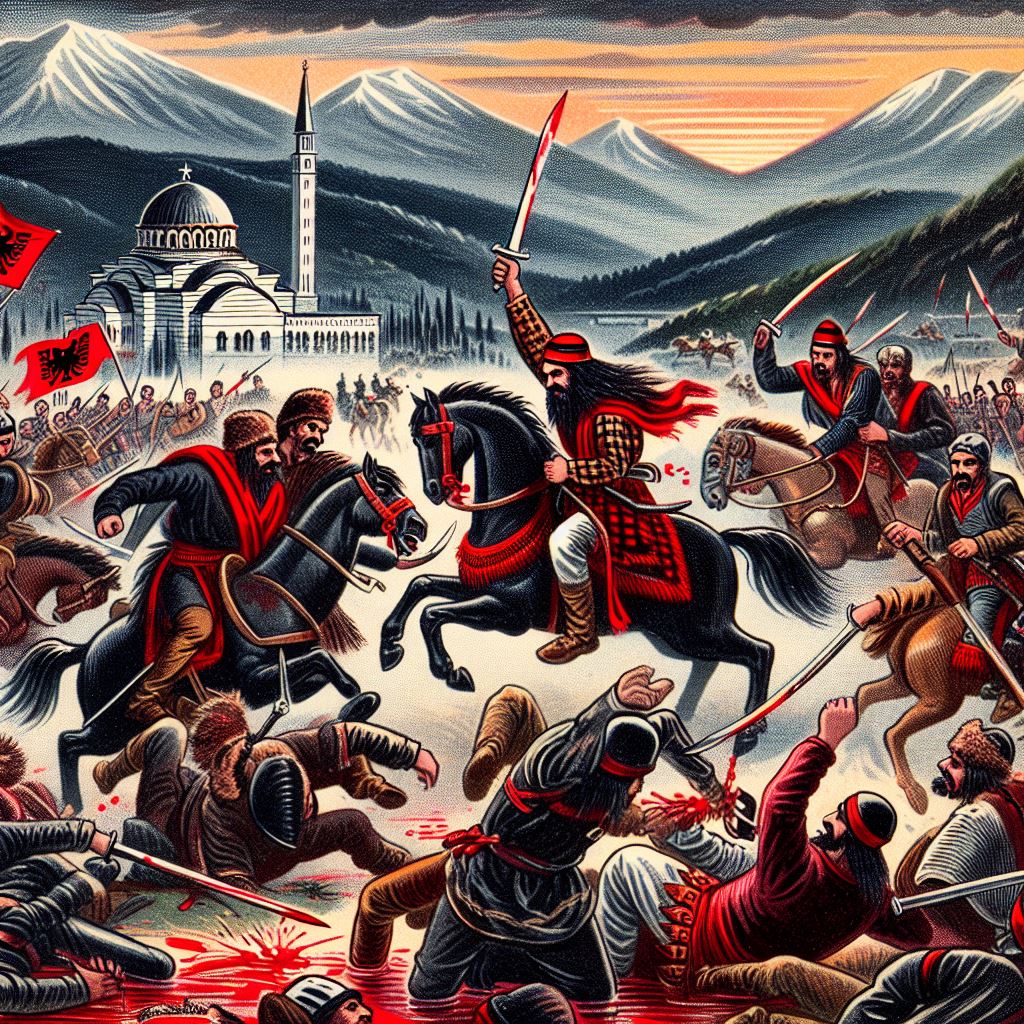
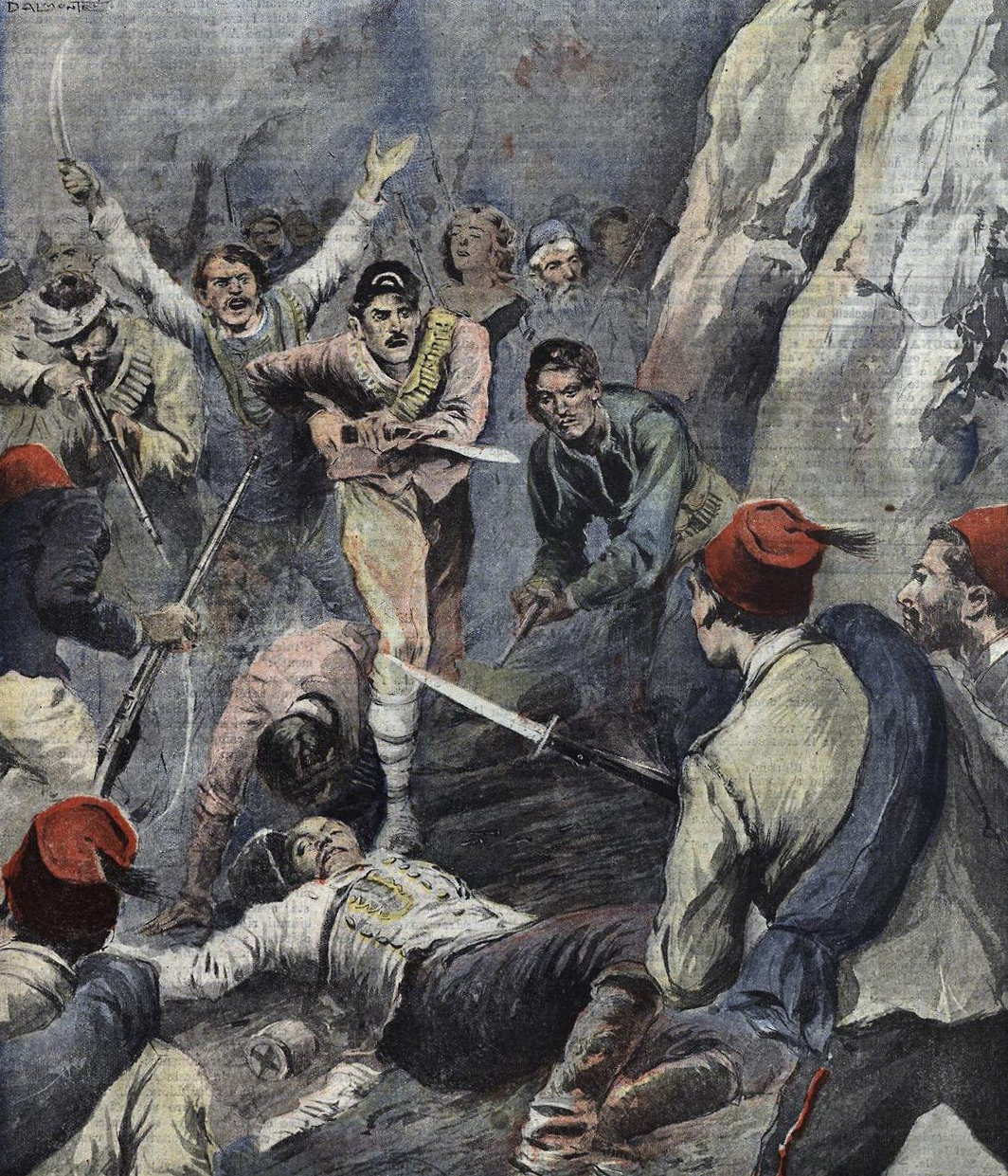
Long oppressed by the corrupt Ottoman Empire, Albania sought independence from Turkish domination. To this end, the Albanian independence movement aided the Young Turk movement in its effort to overthrow the old Ottoman regime and radically reform Turkish government. In return for this aid, the Albanians understood that they would be granted a significant measure of self-government and relief from Ottoman taxation. After achieving control of the Ottoman government in 1908, however, the Young Turks reneged on the promise made to the Albanians. Worse, the new Turkish government levied even more burdensome taxes on Albania. This prompted an organized, militant rebellion on the part of some 8,000 northern Albanians. Beginning in March 1910, the uprising
spread rapidly southward, to Korçë, Albania, and even into parts of Macedonia. The first revolt broke out north of the Kosovo province in March 1910. Initially, the Turks could field no more than 16,000 men against some 20,000 rebels. By May 1910 reinforcements swelled the Turkish units to 40,000, and the rebellion was put down. Nevertheless, emboldened by the growing independence movement, Albanian leaders convened in Montenegro to draw up a demand for self-government, which they submitted to the Turks. In response the Turkish government dispatched a large army force, which quickly and savagely put down the rebellion during June 1910. The brutally established peace was short lived. In March 1911 some 4,000 rebels struck again in the north. Rebellion pushed southward until the Turks restored peace by making modest concessions to Albanian autonomy. The next year, however, more than 3,000 Albanians staged an uprising in May. Before the year was out rebel strength had reached about 20,000, and the Albanians took the city of Prisˇtina. At this point, however, the rebellion was swallowed up in the larger FIRST BALKAN WAR.
Idriz Seferi and his men near Ferizaj (1910)
During the first months of 1910, Isa Boletini tried to coordinate forces for a new insurrection by visiting the Albanian clans, which had taken refuge in Montenegro after the failure of a previous minor uprising in 1909. In the meantime the new governor, Masar Bey, introduced a new tax on commodities, which immediately became highly unpopular. Albanian leaders held two other meetings in İpek (now Peć) and Ferizoviç (now Ferizaj), where they took the oath of besa to be united against the new Ottoman government policy of centralization. Forces led by Isa Boletini attacked the Ottoman forces in Pristina and Ferizoviç, while the commander of Ottoman forces in Peć was killed by the local population. The Ottoman government declared martial law and sent a military expedition of 16,000 men led by Shefqet Turgut Pasha who went to Skopje in April 1910.
At the same time 3,000 Albanians under Idriz Seferi blocked the railway to Skopje at the Kaçanik Pass. They captured a train conveying soldiers and military supplies to the Ottoman garrison of Pristina, disarmed the soldiers and held the supplies. The Ottoman forces attacked the Kaçanik Pass but the resistance given there by the Albanians led by Idriz Seferi made it clear that the 16,000 Ottoman forces were insufficient to crush the rebellion so their numbers increased to 40,000 men.After two weeks of fierce fighting, the Ottoman forces captured the Kaçanik Pass and attacked the Albanian forces led by Isa Boletini and Hasan Budakova, which meanwhile were blocking the Ferizovik-Prizren road to Carraleva Pass. Superior in numbers, the Ottoman forces tried at first a frontal attack but the stiff resistance offered made them change their tactics. They made a pincer movement, trying to encircle the Albanian forces in Carralevo pass.
After three days of fighting the Albanian forces withdrew to the Drenica region. Ottoman forces entered Prizren in the middle of May 1910. They proceeded to Yakova and İpek where they entered on June 1, 1910. By government orders part of the force proceeded in the direction of Scutari (now Shkodër), while another column marched toward the Debre region (now known as Dibër in Albania, and Debar in the Republic of North Macedonia). The first column marching to Scutari managed to capture the Morinë pass, after fighting with the Albanian forces of Gash, Krasniq and Bytyç areas, led by Zeqir Halili, Abdulla Hoxha, and Shaban Binaku. Ottoman forces were stopped for more than 20 days in the Agri Pass, from the Albanian forces of Shalë, Shoshë, Nikaj and Mërtur areas, led by Prel Tuli, Mehmet Shpendi, and Marash Delia. Unable to repress their resistance, this column took another way to Scutari, passing from the Pukë region.
Aftermath
Although the numbers of the Ottoman forces were now up to 50,000, they controlled only the lowlands and the cities, and failed to take control of the mountainous regions. At the request of the Ottoman commander Mehmet Shefqet Pasha, the Ottoman government declared the abrogation of the “Lekë Dukagjini Code” which was the mountain law of the Albanian clans. Some Albanian clans went to seek refuge in Montenegro, requesting an amnesty from the Ottoman government and the return of the conditions obtained before the rebellion. This was not accepted by the Ottoman government, which also declared the prohibition of the Albanian alphabet and books published in it. Albanian-language schools were declared illegal, and possessing a book in Albanian letters became a penal act. Strong through numbers and position, the Ottoman expedition continued its march towards central and southern Albania imposing the new prohibitions. Albanian schools were closed and publications in the Latin alphabet were declared illegal. A number of journalists and publishers were fined or sentenced to death while the entry of Albanian books published outside the Ottoman Empire was prohibited. After these events, Albania became a wasteland for Albanian patriots, and Albanian culture was fully oppressed. One year later, Sultan Mehmed V visited Pristina and declared an amnesty for all who had participated in the revolt, except for those who had committed murder.
The Albanian revolts of 1910 and 1912 were a turning point that impacted the Young Turk government which increasingly moved from a policy direction of pan-Ottomanism and Islam toward a singular national Turkish outlook.
Further reading: Kristo Frashëri, The History of Albania: A Brief Survey (Tirana, Albania: N. Pub., 1964).


 Albania