
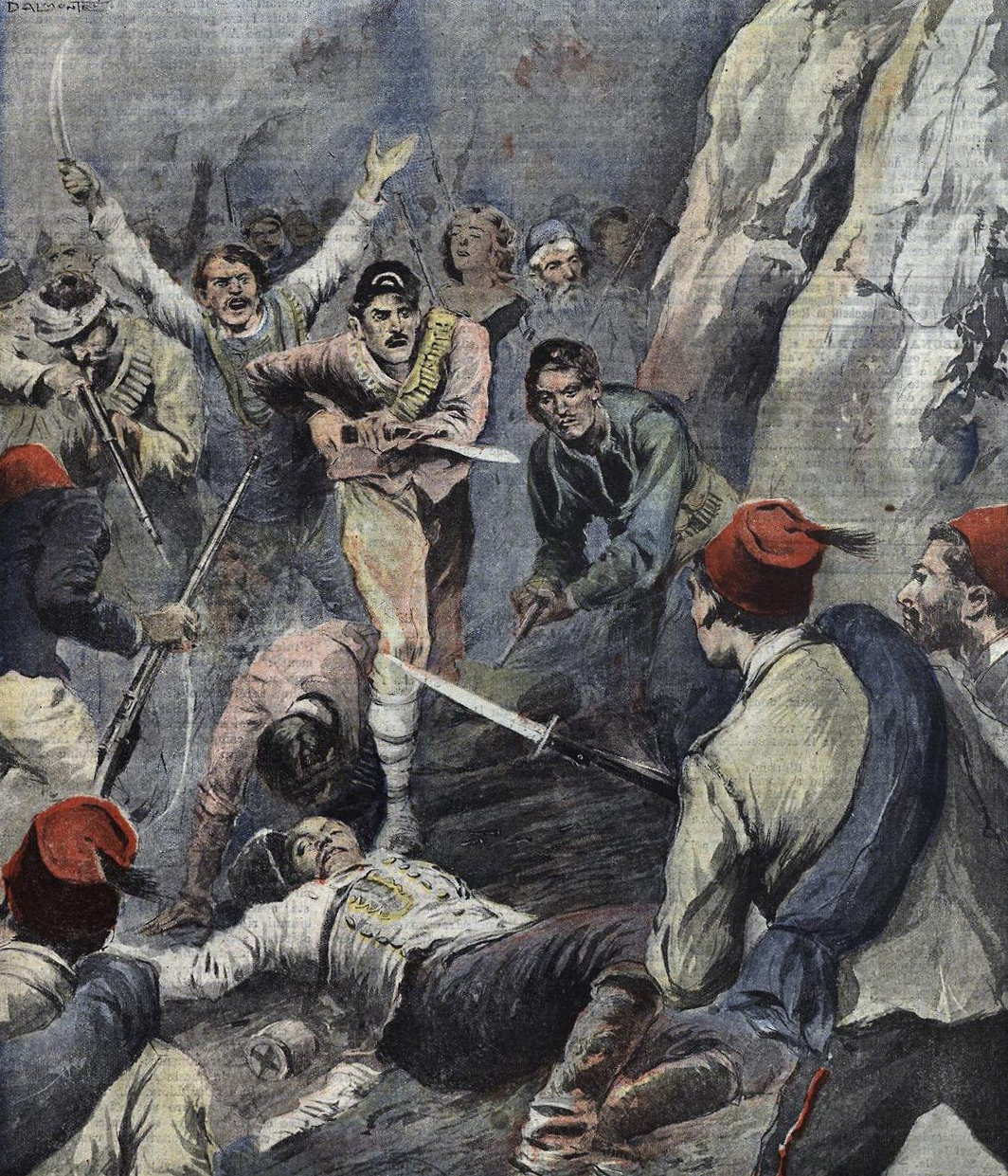
Long oppressed by the corrupt Ottoman Empire, Albania sought independence from Turkish domination. To this end, the Albanian independence movement aided the Young Turk movement in its effort to overthrow the old Ottoman regime and radically reform Turkish government. In return for this aid, the Albanians understood that they would be granted a significant measure of self-government and relief from Ottoman taxation. After achieving control of the Ottoman government in 1908, however, the Young Turks reneged on the promise made to the Albanians. Worse, the new Turkish government levied even more burdensome taxes on Albania. This prompted an organized, militant rebellion on the part of some 8,000 northern Albanians. Beginning in March 1910, the uprising
spread rapidly southward, to Korçë, Albania, and even into parts of Macedonia.
The first revolt broke out north of the Kosovo province in March 1910. Initially, the Turks could field no more than 16,000 men against some 20,000 rebels. By May 1910 reinforcements swelled the Turkish units to 40,000, and the rebellion was put down. Nevertheless,
emboldened by the growing independence movement,
Albanian leaders convened in Montenegro to draw up a demand for self-government, which they submitted to the Turks. In response the Turkish government dispatched a large army force, which quickly and savagely put down the rebellion during June 1910. The brutally established peace was short lived. In March 1911 some 4,000 rebels struck again in the north. Rebellion pushed southward until the Turks restored peace by making modest concessions to Albanian autonomy. The next year, however, more than 3,000 Albanians staged an uprising in May. Before the year was out rebel strength had reached about 20,000, and the Albanians took the city of Prisˇtina. At this point, however, the rebellion was swallowed up in the larger FIRST BALKAN WAR.
During the first months of 1910, Isa Boletini tried to coordinate forces for a new insurrection by visiting the Albanian clans, which had taken refuge in Montenegro after the failure of a previous minor uprising in 1909. In the meantime the new governor, Masar Bey, introduced a new tax on commodities, which immediately became highly unpopular. Albanian leaders held two other meetings in İpek (now Peć) and Ferizoviç (now Ferizaj), where they took the oath of besa to be united against the new Ottoman government policy of centralization. Forces led by Isa Boletini attacked the Ottoman forces in Pristina and Ferizoviç, while the commander of Ottoman forces in Peć was killed by the local population. The Ottoman government declared martial law and sent a military expedition of 16,000 men led by Shefqet Turgut Pasha who went to Skopje in April 1910.
At the same time 3,000 Albanians under Idriz Seferi blocked the railway to Skopje at the Kaçanik Pass. They captured a train conveying soldiers and military supplies to the Ottoman garrison of Pristina, disarmed the soldiers and held the supplies. The Ottoman forces attacked the Kaçanik Pass but the resistance given there by the Albanians led by Idriz Seferi made it clear that the 16,000 Ottoman forces were insufficient to crush the rebellion so their numbers increased to 40,000 men.After two weeks of fierce fighting, the Ottoman forces captured the Kaçanik Pass and attacked the Albanian forces led by Isa Boletini and Hasan Budakova, which meanwhile were blocking the Ferizovik-Prizren road to Carraleva Pass. Superior in numbers, the Ottoman forces tried at first a frontal attack but the stiff resistance offered made them change their tactics. They made a pincer movement, trying to encircle the Albanian forces in Carralevo pass.
After three days of fighting the Albanian forces withdrew to the Drenica region. Ottoman forces entered Prizren in the middle of May 1910. They proceeded to Yakova and İpek where they entered on June 1, 1910. By government orders part of the force proceeded in the direction of Scutari (now Shkodër), while another column marched toward the Debre region (now known as Dibër in Albania, and Debar in the Republic of North Macedonia). The first column marching to Scutari managed to capture the Morinë pass, after fighting with the Albanian forces of Gash, Krasniq and Bytyç areas, led by Zeqir Halili, Abdulla Hoxha, and Shaban Binaku. Ottoman forces were stopped for more than 20 days in the Agri Pass, from the Albanian forces of Shalë, Shoshë, Nikaj and Mërtur areas, led by Prel Tuli, Mehmet Shpendi, and Marash Delia. Unable to repress their resistance, this column took another way to Scutari, passing from the Pukë region.
Aftermath
Although the numbers of the Ottoman forces were now up to 50,000, they controlled only the lowlands and the cities, and failed to take control of the mountainous regions. At the request of the Ottoman commander Mehmet Shefqet Pasha, the Ottoman government declared the abrogation of the “Lekë Dukagjini Code” which was the mountain law of the Albanian clans. Some Albanian clans went to seek refuge in Montenegro, requesting an amnesty from the Ottoman government and the return of the conditions obtained before the rebellion. This was not accepted by the Ottoman government, which also declared the prohibition of the Albanian alphabet and books published in it. Albanian-language schools were declared illegal, and possessing a book in Albanian letters became a penal act. Strong through numbers and position, the Ottoman expedition continued its march towards central and southern Albania imposing the new prohibitions. Albanian schools were closed and publications in the Latin alphabet were declared illegal. A number of journalists and publishers were fined or sentenced to death while the entry of Albanian books published outside the Ottoman Empire was prohibited. After these events, Albania became a wasteland for Albanian patriots, and Albanian culture was fully oppressed. One year later, Sultan Mehmed V visited Pristina and declared an amnesty for all who had participated in the revolt, except for those who had committed murder.
The Albanian revolts of 1910 and 1912 were a turning point that impacted the Young Turk government which increasingly moved from a policy direction of pan-Ottomanism and Islam toward a singular national Turkish outlook.
Further reading: Kristo Frashëri, The History of Albania: A Brief Survey (Tirana, Albania: N. Pub., 1964).
https://en.wikipedia.org/wiki/Albanian_revolt_of_1910?wprov=sfla1
 Albania