
Outside observers tend to think of Albania as a monolithic bloc, but just below the “Greater Albania” surface is a depth of societal division, periodically drained by the “unifying” valve of ethnic irredentism. The country is suffering from such a degree of corruption and mismanagement that thousands of its citizens have opted to flee and begin their lives anew in Germany, which has only contributed to the economic crisis that Albania has found itself in and raises fears of oncoming political unrest. Something else that needs to be spoken about when addressing domestic Albanian divisions is the potential for the Gheg and Tosk geographical dialect divisions to coalesce into concrete regionalist identities that weaken the cohesiveness of the Albanian state.
Squeezed between grassroots socio-economic pressures and the threat that the geo-dialect divide might one day take on political contours, the Tirana elite has resorted to the myth of “Greater Albania” in order to maintain ‘unity’ and redirect society’s growing anger towards a ‘regional crusade’. What they may not have calculated, however, is that the country’s strategic Christian minority might one day identify closer with their neighboring co-confessionalists than the with the diversion of “Greater Albania”, and if they take the lead in exposing this charade, then the entire national fabric might eventually unravel in unpredictable directions.
The article starts off by highlighting the economic desperation prevalent in Albania and its occupied colony of Kosovo and how the huge migrant flows this has stimulated have given Tirana’s elite a serious cause for self-interested concern. Afterwards, it explores the Gheg and Tosk dialect divide and the prospects for its politicization in the future, especially in the absence of a ‘unifying’ “Greater Albania” ideology or a major weakening thereof. Part II continues the research by examining the potential for Albania’s Christian minority to play the vanguard role in leading the domestic resistance to the “Greater Albania” ‘theology’. Following that, it looks at the possibility of the government responding through a Turkish-supported ‘soft’ Islamization of society to counter the Christian dissidents, with all of the unintentional and explosive problems that this could predictably create. Finally, the work concludes by assessing the most probable impact of all these processes on Albanian society and touching upon three interrelated scenarios.
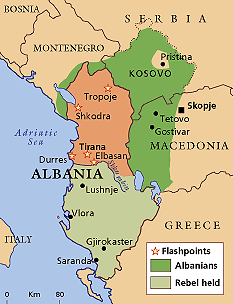
Lost amidst the news-grabbing headlines about the Mideast’s migrant crisis to Europe is the internal one that hit uncontrollable proportions at the beginning , but was soon eclipsed by its more politically convenient counterpart. The Independent Balkan News Agency reported in April that 20,000 Albanians had already left their country in search of better opportunities in the EU, with The Telegraph writing in late February that 50,000 Albanians had left Kosovo by that time for the same reason. Taken together, that’s at least 70,000 Albanians that have fled the Balkans by early 2015, but unfortunately for observers, news coverage about this mass exodus was overshadowed as the Mideast migrant crisis began spiraling out of control, and it has since then been extremely difficult to find reliable figures about the number of Albanian migrants since, let alone any detailed coverage in general.
Step Out Of The Shadows, Get Deported:
A mid-summer article from Euroactiv counted around 8,000 Albanians requesting asylum in Germany, despite the 2% or so success rate for that group at the time. More than likely, the rest of the at least 70,000 Albanian migrants didn’t even want to apply for asylum because they knew the almost impossible odds of receiving this benefit and also suspected their departure entities would soon be put on a list of “safe countries” that would lead to the deportation of 98% of those said applicants. Choosing instead to treat their stay in Germany not as a lifelong new beginning but an indefinite working trip, they opted not to notify authorities of their presence. In hindsight, this was a wise decision on their part because Germany eventually did declare Albania and “Kosovo” “safe countries” and has already begun deporting 716 of the prior applicants (almost 9% of the total) back to Tirana within a month of making the decision.
Unwanted In Their Own Country:
Although proportionately small in number when compared to all the Albanians that have fled so far this year (and obviously more by now than the 70,000 that were counted in spring), Tirana is afraid that a large wave of deported individuals will soon arrive back in the country. These angry and unemployed individuals might rightly begin agitating against the government and demanding real economic change in their country, and that’s what really makes the elite anxious. Furthermore, deported Albanians that return to the occupied Serbian Province of Kosovo might refrain from making such a trip again and instead opt to find a job in Albania instead, which would further strain the domestic labor market and increase unemployment.
Written by Andrew KORYBKO
 Albania